Table Of Contents
TL;DR
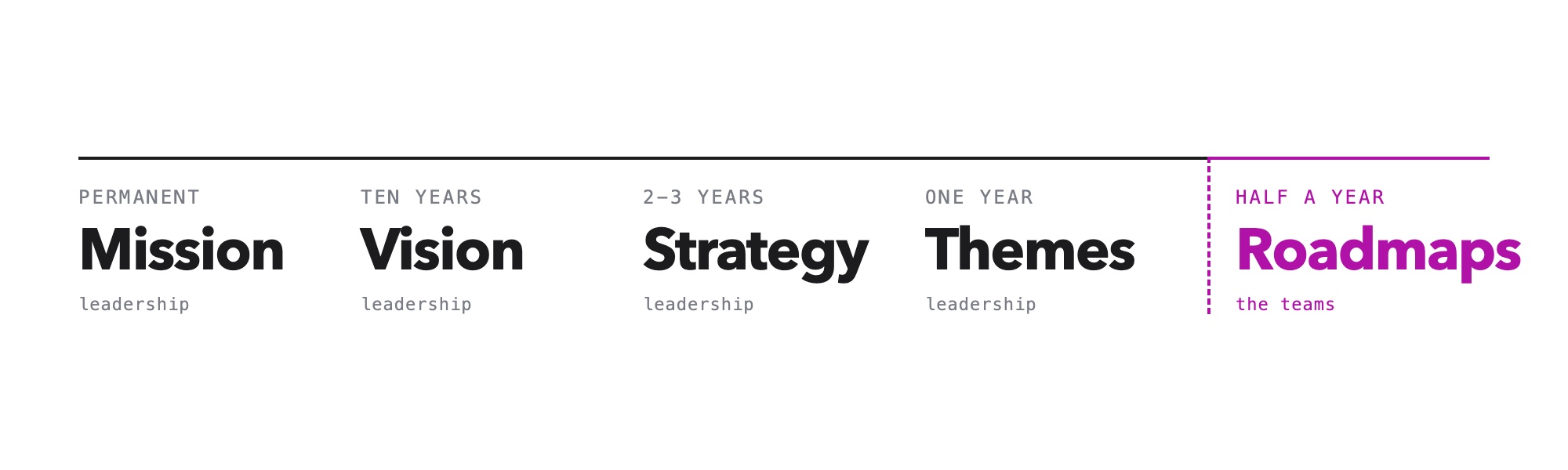
- Four levels, four lifetimes. Mission (permanent), vision (about ten years), strategy (two to three years), themes (one year). Leadership writes them in words. The teams write the roadmaps.
- The mission is the main quest. It says what the customer gets. Use the words the founder already has.
- A strategy leaves something out. It names the one or two of Helmer’s 7 Powers you want to build, what comes second, and what you will not do this year.
- Themes name outcomes for the customer, in words and without target numbers. Never a segment, a technology or a team.
- Stability and AI are not themes. The foundation gets reserved capacity, and each AI idea belongs to the theme where its result shows.
- Two lists travel with the themes: the numbers everyone watches and the dates nobody chooses.
- The handoff takes about three weeks. Teams brainstorm, sketch two to four big chunks per half-year and say what they stop.
- Shopify works this way. Tobi Lütke sets yearly themes, the teams turn them into rough six-month roadmaps, and there are no formal OKRs.
Why yearly plans stall
Most plans reach the teams in one of three shapes. Each one costs something.
The project list. Leadership decides what gets built, and the teams estimate and deliver. It is quick to write and easy to track. It also tells the people closest to the customer and to the code that their ideas come second. The best ideas of the year never get proposed, and nobody feels responsible for the outcome of a project they did not choose.
The OKR tree. Company objectives break down into department key results and then into team key results. On paper, everyone is aligned. In practice, teams spend weeks negotiating numbers, and a number that becomes a target soon stops measuring what it was meant to measure. That is Goodhart’s law, and it is the reason Shopify’s CEO gives for not running OKRs.
No plan at all. Every team works through its own backlog. The year ends with a lot shipped and little the company can point to.
A short chain works better. It runs from why the company exists to where it wants to get better this year. Leadership writes it in words, and the teams decide what to build. I used this approach in a recent interim CPTO mandate to hand the yearly planning to the product and engineering teams. Shopify works the same way: Tobi Lütke sets a few themes each year, and the product teams turn them into their roadmaps. Shopify is the example throughout this article.
The themes say where we are going. The teams decide how we get there.
Four levels, four lifetimes
Each level changes at a different speed. Mixing them in one list is the most common reason a plan confuses people.
| Level | Lifetime | What it is | Who writes it |
|---|---|---|---|
| Mission | Permanent | Why the company exists. The test for every project | Leadership |
| Vision | About ten years | The customer’s world once you have won | Leadership |
| Strategy | Two to three years | The choice of how you win, and what comes second | Leadership |
| Themes | One year | Where you want to get better this year, in words | Leadership |
| Roadmaps | Half a year | The big chunks of work each team takes on | The teams |
The handoff sits between the themes and the roadmaps. Two lists travel with the themes: the numbers everyone watches and the dates nobody chooses.
My own first draft for a client got this wrong. Its list of strategic pillars held outcomes, a product, a marketing claim and two conditions, side by side. It looked complete and gave no direction. Sorting each item into the level where it belongs fixed it.
Mission: the main quest
Shopify’s mission is “making commerce better for everyone”. In a 2023 letter to employees, its CEO Tobi Lütke called the mission the company’s main quest and everything else a side quest. The same letter announced the sale of Shopify’s logistics business, a side quest that had grown large.
A good mission says what the customer gets. “We make it simple” describes you. “Helping every practice succeed” describes your customer, and it gives every team a test for every project: does this help our customer succeed, and can we show it? Work that fails the test is a side quest. Stop it, or put a price on it.
Use the words that already exist. Founders have usually written their purpose down already, on the second slide of an investor deck or on the careers page. Take their words. A mission the founder recognizes as their own is agreed in minutes. A new one starts a debate that has nothing to do with the year ahead.
Vision: the world once you have won
The vision describes your customer’s world in about ten years, once the mission has worked. It is a picture, written in one sentence and explained in one paragraph. If the founders have an ambition with a number in it, such as a customer count or a market position, put it in. Then the vision and the company plan point the same way.
Shopify keeps its vision implicit. Its About page speaks of a future of commerce with “more voices, not fewer”, and in 2015 Lütke wrote that he wants to build a company that sees the next century. You can be that brief too, as long as everyone in the company could draw the picture.
Strategy: a choice that leaves something out
Richard Rumelt’s definition is still the most useful one. A strategy has three parts: a diagnosis of the situation, a guiding policy for dealing with it, and a set of actions that fit together. A list of goals is not a strategy, however ambitious the goals are.
Name the Power you want to build. Rumelt tells you what a strategy is. Hamilton Helmer’s 7 Powers tell you whether the win will last. A Power is a benefit for you combined with a barrier that keeps competitors from copying it: scale economies, network economies, counter-positioning, switching costs, branding, a cornered resource or process power. A good strategy picks one or two of them and says how this year moves you toward them. Helmer also shows that not every Power is open at every stage. Counter-positioning and a cornered resource come early, network economies, scale economies and switching costs during the take-off, branding and process power only once you are big. For most SaaS companies between product-market fit and scale, the realistic candidates are switching costs, counter-positioning and network economies built on data.
Write the strategy as one sentence that starts with “This year we win by …”. Follow it with three or four reasons that come from the diagnosis. Then add the two parts that most strategies leave out:
- What comes second. Capacity is the constraint in every software company, and the strategy decides where it goes first. A strategy that puts nothing second is a wish list.
- What you will not do this year. Four lines are enough. They prevent more arguments during the year than anything else in the document.
Three tests help. First, would a sensible competitor choose the opposite? If not, you have written a platitude, and “We focus on our customers” fails. Second, is it a strategy or a superlative? “The best checkout in our industry” sounds like a strategy and is really an ambition you have to earn. Measure first and claim later. In Germany, a competitor can send a costly warning letter for a claim to be the best that you cannot prove. Third, which Power does it build? If you cannot name the barrier that stops a competitor from copying it, the win will not last.
Check the draft against the company plan, in both directions. Look for revenue in the plan that no work stands behind, and for work in progress that earns nothing in the plan. Then check the order of things. When I checked one draft against the CEO’s plan, the biggest gap was the sequence. The draft moved a product line a year later than the plan the investors had already seen. Your strategy may differ from the plan. It should differ on purpose, and the CEO should agree before the teams read it.
Themes: where to get better this year
Three to five themes, each named after an outcome for the customer. At Shopify, Lütke sets the themes once a year, and every team plans against them.
A theme names something the customer will notice, in words a new engineer understands on the first reading. It carries no target number. The numbers sit in the cockpit, where every team can see them.
Each theme says which Power it builds. If the strategy names switching costs, at least one theme has to make leaving you harder for the customer, for the right reasons. Some themes build no Power at all. They are table stakes: work you need to compete, such as a feature every rival already has. Say so in the theme, and keep table-stakes themes small. If no theme builds the Power the strategy names, the strategy is decoration.
Shopify writes its themes from the merchant’s point of view. In the year its VP of Product described to Lenny’s Newsletter, there were six, and one of them read “Shopify keeps me on the cutting edge”.
How to name a theme
- Write a sentence the customer could say. If a customer would never say it about you, it is an internal goal.
- Name the outcome. A theme named after one customer segment is usually too narrow. In one draft, “Ready for large customers” became “Open by default”: an API that serves every customer, the large ones included.
- Leave technologies out. “AI” is a means. Each AI idea belongs to the theme where its result shows.
- Leave teams out. Most themes need several teams, and most teams contribute to more than one theme.
Anatomy of a theme
| Part | What goes in |
|---|---|
| Name | An outcome the customer notices, in plain words |
| What it means | Two or three sentences, written from the customer’s side |
| Power it builds | The Power from the strategy that this theme moves you toward, or “table stakes” |
| What likely goes in | Starting points from work already running or written down. The teams can replace them |
| Open questions | What we do not know yet. The teams answer what they can |
| Numbers we would watch | Signals that show the theme is working. Watched, never assigned |
| Teams likely involved | A first guess that helps teams find each other early |
The list of what likely goes into a theme needs the most care. Without it, teams start from a blank page. Presented as a list of orders, it turns the themes back into a project list. Say in the document, in so many words, that these are starting points the teams can replace.
What stays outside the themes
Two topics come up in every planning round. Both belong somewhere else.
The foundation
Stability, security, current systems and fast, safe deployments. Nobody can choose against them, so they are not themes. Every team reserves a fixed share of its time for them before it plans anything else.
Shopify’s engineering blog describes a 25 percent rule for technical debt: about 10 percent of time improving the code you are working in anyway, 10 percent on debt the team picks, and 5 percent on larger items each month and year.
Draw one line. Modernization that changes what the customer gets, such as the rewrite of a core product, is a bet inside a theme. Modernization that keeps you current is paid from the reserved share.
AI
AI is a way to reach a result, so it gets no theme of its own. An AI theme produces demos. Each AI idea names the theme it serves and the number it should move. AI in your own engineering belongs to the foundation.
Shopify’s CEO made the same point in 2025 when he called AI use a baseline expectation for everyone. AI is how the work gets done. The themes say what the work is for.
Numbers to watch, dates to plan around
Two short lists travel with the themes. They give the plan its edges.
The cockpit. Six to eight company numbers: recurring revenue, churn, activation of new customers, one usage number tied to the strategy, uptime. Every team sees them, and no team owns one alone as a target. Some will read “not measured yet”. Say so. Measuring them becomes work inside a theme.
Fixed points. Dates set outside the teams: regulatory deadlines, contract ends, the end of life of a runtime or a vendor’s API, dates promised to large customers, pilots already agreed. The teams plan around them. The first list is never complete, so ask each team to add the dates it knows.
The handoff
What you ask from each team:
- Brainstorm against the themes. What do we have, what is missing, what would you do? Ideas that are not in the document are welcome as long as they serve a theme.
- Sketch the year. Two to four big chunks per half-year. For each one: the theme it serves, the number it should move, a rough size, and what it needs from other teams. A chunk without a natural owner goes in anyway, marked “owner open”.
- Say what you would stop or not start. A plan that only adds work is not finished.
- Answer the open questions you can, and mark the ones you cannot.
A rough plan is enough. The first half-year is a commitment and the second is direction. Shopify uses the same horizon: each theme turns into a rough six-month roadmap. Tell the teams that the org chart may follow the plan: where the bets do not fit today’s teams, reorganize at a half-year boundary.
| When | What happens |
|---|---|
| Week 1 | Leadership agrees on mission, vision, strategy and themes, and the CEO signs off on the strategy. Then an intro session for all teams: the document, the reasoning behind it, the open questions |
| Week 2 | Teams brainstorm and sketch. At the end of the week, each team presents what it achieved this year and what it plans for next year, against the themes |
| Week 3 | Leadership gives feedback, the plans are final, and the first half-year is committed |
| Every quarter | A short review commits the next quarter, and each finished bet gets a results review |
Shopify runs every project through five reviews in a homegrown tool called GSD: proposal, prototype, build, release and results. Most companies skip the last one.
Shopify, level by level
Everything below comes from public sources: Lütke’s letters, interviews with Shopify’s product leaders, and Shopify’s engineering blog.
| Level | At Shopify |
|---|---|
| Mission | “Making commerce better for everyone.” Lütke calls it the main quest. Everything else is a side quest |
| Vision | Never written as one sentence. The About page speaks of a future of commerce with “more voices, not fewer”, and Lütke wants a company that sees the next century |
| Strategy | Choices that leave things out. In 2023 Shopify sold its logistics business to Flexport and called logistics a side quest |
| Powers (my reading) | Counter-positioning against Amazon: merchants keep their brand and their customers, which a marketplace cannot offer without weakening itself. Network economies through Shop Pay: a buyer’s saved details work in every Shopify store |
| Themes | Lütke sets them once a year, always from the merchant’s point of view. In the year described in the interview, there were six |
| Roadmaps | Each theme turns into a rough six-month roadmap |
| Fixed points | Editions, the big releases that bundle hundreds of improvements. At the time of the interview they came twice a year |
| Project reviews | GSD, a homegrown tool. Every project passes five reviews: proposal, prototype, build, release and results |
| Numbers | No formal OKRs. Lütke cites Goodhart’s law and calls the company data-informed |
| Foundation | The 25 percent rule: a standing share of engineering time for technical debt |
| AI | A baseline expectation since 2025. Teams show why AI cannot do a job before they ask for more people |
Two habits are worth copying first. The themes are sentences a merchant could say, so every team knows whom it builds for. And the last review looks at results, so a project is not finished when it ships.
Your first page, filled in
Shopify’s own planning documents are not public. This fictional company shows what the first page could look like: software for independent physiotherapy practices, with scheduling, billing, a patient app and payments.
| Mission | Helping every practice spend its time on patients |
| Vision | Independent practices run as well as the large chains, and most of them run on our software |
| Strategy this year | We win on the calendar: a practice fills more of its therapists’ hours with our software than with any other |
| Powers we build | Switching costs: a practice’s schedule, patient history and integrations live with us. Counter-positioning against booking marketplaces that charge per booking: they cannot offer free direct booking without hurting their own model |
| Second | Billing automation, in the first version that can be sold |
| Not this year | A hospital edition. A public claim to the best booking in the market before we have measured it. AI features that move no number in the cockpit |
| Theme: A full calendar | Online booking, reminders that cut no-shows, a waitlist that fills cancelled slots. Builds switching costs and counter-positioning |
| Theme: Every kind of practice | Group practices with several locations, and new specialties. Table stakes: competitors already serve group practices |
| Theme: Open by default | A public API, and integrations with insurers and accounting tools. Builds switching costs |
| Theme: Live in a day | Data import, setup without a call, and a monthly view of what the software earned the practice. Builds no Power, but lowers the cost of winning a customer |
| Foundation | Stable, secure, current, fast to change. A fixed share of every team’s time |
| Cockpit | Recurring revenue, churn, share of therapist hours booked, share of bookings made online, days from signature to live, uptime |
| Fixed points | An e-invoicing deadline, the end of life of a payment provider’s old API, a pilot with a large group practice |
Mistakes I see most often
- One list that mixes levels: outcomes, products, claims and conditions side by side.
- A strategy with nothing second and nothing left out.
- A strategy that names no Power, or themes that build none of the Powers it names.
- Target numbers for each team.
- Themes named after segments, technologies or teams.
- No reserved share for the foundation, which slowly gives back the stability you built.
- A draft never checked against the company plan and against what investors have heard.
- A new mission when the founder already has one.
- Starting points presented as orders.
Takeaway
A yearly plan does not have to be a list of projects. Write four short things in words, add the numbers everyone watches and the dates nobody chooses, and give the teams three weeks to turn the themes into their own roadmap. You get a plan the teams own, and you find out early where their view of the year and yours differ.
More
- Related: Hamilton Helmer’s 7 Powers, Plan Like Amazon and Customer-Driven vs. Product-Driven Roadmap
- Planning next year with your teams and want a second pair of hands? Interim and fractional CTO
- Shopify’s mission: Shopify Investor Relations
- Main quest and side quests: Tobi Lütke, “Important team and business changes”, 2023
- Yearly themes, six-month roadmaps and GSD: Lenny’s Newsletter, “How Shopify builds product”, an interview with Glen Coates, VP of Product
- A GSD review in practice: Behind the Craft, “How Shopify built generative AI”
- Planning without OKRs: Lenny’s Newsletter, “Tobi Lütke’s leadership playbook”
- Reserved time for technical debt: Shopify Engineering on the 25 percent rule
- AI as a baseline expectation: BetaKit on Tobi Lütke’s 2025 memo
- What a strategy is: Richard Rumelt, Good Strategy Bad Strategy, 2011


