Table Of Contents
TL;DR
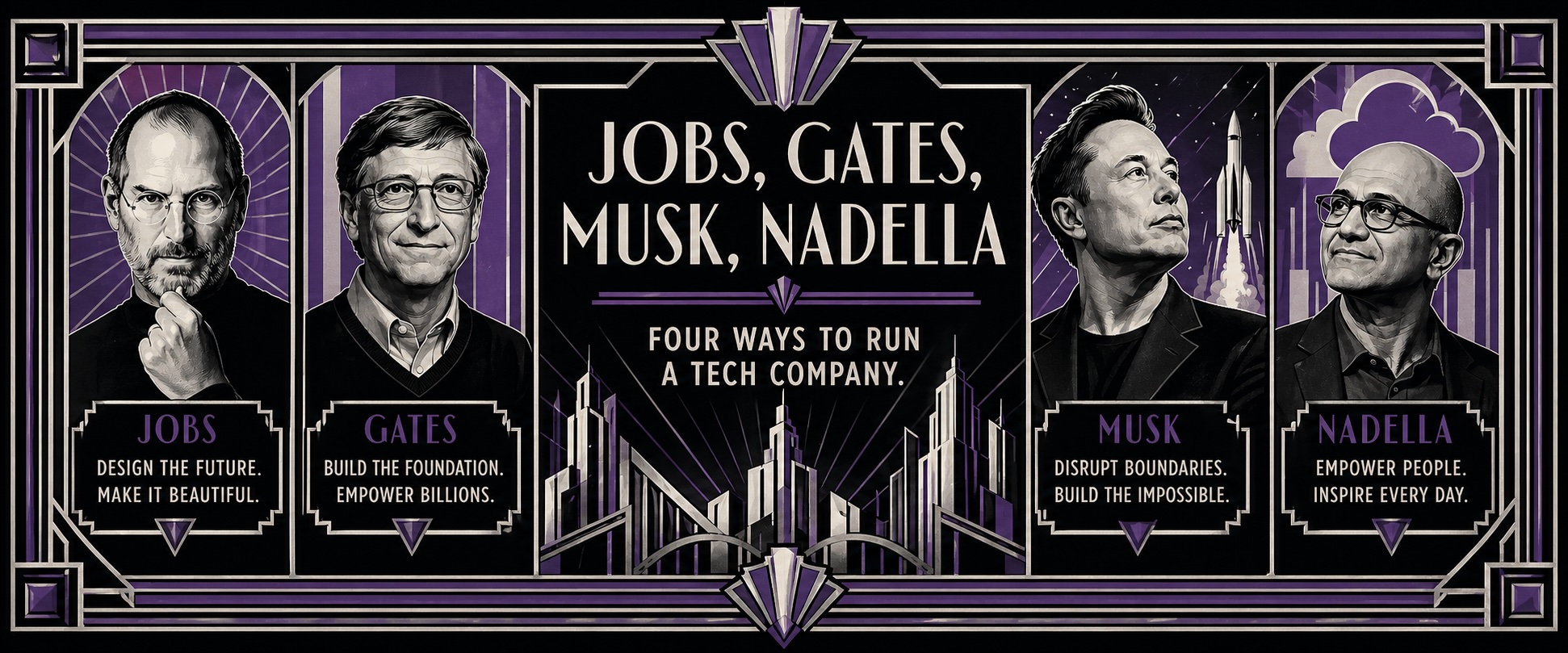
- Steve Jobs has become the default reference for tech leadership, but he is one data point among several. Putting him next to Gates, Musk, and Nadella is a far more useful exercise than holding him up as a template
- Jobs led through taste and intuition. Gates led through logic and analytical pressure. Musk leads through urgency and operational brute force. Nadella leads through clarity, empathy, and culture
- All four built or rebuilt enormous companies. None of their styles is universal, and not all of them are equally healthy or equally replicable
- The style most managers should actually copy is probably not the one their LinkedIn feed keeps suggesting
- As an interim CTO my job is often to give founders and CEOs an honest outside view of how they lead. The hardest part of that work is not the diagnosis - it is delivering it in a way the leader can actually hear
The Default Template
Most of the founders and CEOs I work with as an interim CTO have, somewhere in the back of their head, a picture of Steve Jobs. They might not say it out loud, but it leaks out in small ways. The product critique that lands a little too sharply. The insistence on being the final taste arbiter for everything. The confidence that “I am hard on people because I care about quality” justifies almost any meeting.
Jobs is the default template for tech leadership and has been for two decades. Books, podcasts, talks, biographies - all of it keeps circling back to him as if he were the one true model. Part of my job is to gently point out that he is not. He is one data point among several, and the right reference for any given leader, at any given moment, is almost never the obvious one. Peter Drucker, who thought about effective leadership more clearly than almost anyone, was very explicit that there is no single personality type that works.
The most useful exercise I have found, both for myself and for the people I advise, is to put Jobs next to three other leaders who built or rebuilt companies of comparable scale: Bill Gates, Elon Musk, and Satya Nadella. Once you do that, the Jobs template stops looking like the answer and starts looking like one option among four - each with very different costs.
The Four at a Glance
Before going into each one, here is the shortest possible version of the four styles side by side. It is a caricature, of course - every leader is more nuanced than four words in a table - but it is a useful map to keep in your head while reading the rest.
| Leader | Core style | Strengths | Common criticism |
|---|---|---|---|
| Steve Jobs | Visionary, perfectionist, confrontational | Product taste, focus, inspiration, bold decisions | Harsh, controlling, toxic at times |
| Bill Gates | Analytical, intense, intellectually combative | Technical depth, strategic thinking, rigor | Dismissive, intimidating, argumentative |
| Elon Musk | Extreme urgency, first-principles, relentless pressure | Speed, ambition, engineering push | Chaotic, punishing, erratic, burnout-inducing |
| Satya Nadella | Empathetic, collaborative, culture-focused | Trust-building, learning culture, steady execution | Less mythic, may seem less “heroic” |
Jobs and Gates
Jobs and Gates are the obvious pairing because they were rivals for so long. They had more in common than either side likes to admit. Both were brilliant. Both were demanding. Both could be brutal in a meeting and indifferent to whether you enjoyed the experience. And both, when you got past the personality, were running their companies with extraordinary clarity.
The difference was the axis they pushed on. Jobs led through taste, intuition, and product vision. He could walk into a review and say “this feels wrong” without showing his work, and the team would go back and rebuild it. The authority came from a track record of being right about things he could not fully articulate - what colleagues called his reality distortion field. Gates was the opposite. He led through logic, technical depth, and relentless analytical questioning. The famous “that’s the stupidest thing I’ve ever heard” is not a line you imagine Jobs delivering - it is a line you imagine after Gates has dismantled your argument piece by piece for ten minutes and concluded that nothing is left of it.
If you ask which of the two seemed more like an asshole, the honest answer is that they were assholes along different axes. Jobs humiliated you in front of the room. Gates dismantled your reasoning until there was nothing standing. One was theatrical. The other was forensic. Neither of them is something you can casually copy without consequences, and the people who try usually end up imitating the abrasive surface without any of the underlying instinct that made it work.
Jobs and Musk
The Jobs/Musk comparison is the one most people reach for today, and for good reason. They share a lot of surface features. Both built a personal mythology around themselves. Both demanded extreme commitment from the people closest to them. Both pushed teams to do things that looked impossible and were rewarded with intense loyalty and intense resentment, often from the same person.
The difference is what they were obsessing over. Jobs cared about end-to-end product elegance. Simplicity, design coherence, knowing when to say no, and polishing things long after most people would have shipped. Musk cares about speed, engineering ambition, manufacturing scale, and brute-force execution. Jobs would hold a product back for a year because the chamfer on the corner was wrong. Musk will ship the rocket and let the explosion teach him what to fix.
If you ask which style is harsher, my honest read - and I have heard a few similar stories first-hand from people who worked at both kinds of company - is that Musk’s style is more punishing operationally. The hours, the weekend pages, the public firings, the demand to be physically present at the factory at three in the morning. Jobs was more punishing interpersonally and aesthetically. Both are brutal. They just hurt people in different ways and on different timescales. There is a useful frame from a different post here: a company can be run like a family or like a pro sports team, and Jobs and Musk both ran something closer to a sports team turned up to eleven - with all the upside and all of the cost that implies.
So Whose Style Should You Copy?
This is the question every founder and CEO eventually asks me, sometimes directly and sometimes through three layers of indirection. They have read the Jobs biography. They have watched the Musk documentary. They have decided their company needs more “intensity” or more “vision” or more “first-principles thinking”, and they want a sanity check on whether they are doing it right.
The honest answer is uncomfortable, because it is rarely the answer they came for.
If you are running a company that needs a once-in-a-decade product breakthrough, and you happen to have the rare instinct to drive that breakthrough yourself, then yes, Jobs is a useful reference - though even then, mostly for the focus and the willingness to say no, not for the personal cruelty. If your organisation genuinely lives or dies by speed and engineering ambition, and your people have explicitly signed up for that bargain with their eyes open, Musk has things worth borrowing - though again, mostly the urgency, not the chaos. If your culture rewards deep technical debate and you have the temperament to lead through analysis, Gates is closer to your model than the other two.
But here is the thing. Most companies are not in any of those situations. Most companies, most of the time, are in the situation where the work is solid but the culture has gone stale, where talented people are quietly disengaging, where strategy keeps stalling because the organisation is fighting itself, where a great product needs to keep being shipped by people who are not going to be intimidated into doing it. In other words, most companies are in the Microsoft of 2014.
And the leader who fixed the Microsoft of 2014 was Satya Nadella.
The Nadella Lesson Most Founders Don’t Want to Hear
Nadella is the least mythologised of the four, and that is part of why his lesson is the one most often missed. He did not arrive with a singular product vision the way Jobs did. He did not bulldoze through engineering constraints the way Musk does. He did not out-debate his executive team the way Gates did. He did something quieter and, in the long run, more impressive. He took an enormous, defensive, internally hostile organisation and made it possible to do good work inside it again.
He did it through clarity, through respect, through cross-team collaboration, through a real, operationalised growth mindset, and through the simple insistence that internal rivalry is not a strategy. The previous regime was famous for stack ranking, the system that pitted teams against each other and that many credit with hollowing out a decade of Microsoft’s product output. The result of getting rid of it, over the decade since, has been one of the largest enterprise reinventions of the modern era - cloud, AI, developer tools, gaming, productivity - all done by mostly the same people who, in the previous regime, were considered the problem.
This is the part that founders find hardest to absorb. They want to believe that intensity and force and personal will are what move companies forward, because that is the story that flatters the founder. Empathy, clarity, and culture sound soft. They sound like HR. They sound like the kind of thing you would say if you did not have any real ideas. But the data is stubborn: Nadella’s Microsoft outperformed almost everyone, including a lot of companies run by louder, harsher, more “Jobs-like” leaders. Culture turned out to be the strategy.
For most managers running most organisations, Nadella is not just a viable model. He is the right one. The Jobs template sells a lot of books, but it costs more than people realise to copy badly - and almost everyone who tries to copy it copies it badly.
Saying This to a Founder Without Losing the Room
When a founder behaves a little too much like the version of Jobs they have constructed in their head, the symptoms show up everywhere. Senior people stop pushing back in meetings because the cost of being publicly humiliated is too high. The product team starts second-guessing every decision against an imagined “what would the boss think” filter that slows everything down. Good engineers leave quietly and the leader hears about it through HR three months later. Strategy reviews become performances rather than thinking sessions. None of these are technical problems. All of them are leadership problems, and most of the time the founder cannot see them because they are inside the system that produces them.
This pattern is exactly what I mean when I say that most problems in a tech department are people problems, not tech problems - and that the right intervention is almost never another framework or another tool. Knowing this is the easy part. Saying it to the founder or CEO who hired you is the hard part, and it is most of what the interim CTO job actually consists of once you get past the stack diagrams and the org chart. It is also a lot of when an interim CTO is actually the right call in the first place.
The outside view is the entire reason an interim CTO is in the room. Not the architecture diagrams - the architecture diagrams are easy. The hard part is being the person who can say, calmly and with evidence, “the way you ran that meeting cost you something” or “the reason this team will not commit to a date is that the last three times they did, you publicly punished them for missing it”. That conversation only works if you have spent the previous weeks earning the right to have it. You cannot drop it on day one. You also cannot avoid it forever, because if you do you are not actually doing the job - you are just running the playbook.
What I have found is that the comparison frame helps. Telling a founder “you should be less like Jobs” lands as criticism. Walking them through Jobs, Gates, Musk, and Nadella as four real options, with real strengths and real costs, lands as a choice. Most leaders, given the choice clearly, will not pick the version of themselves that burns out their best people. They picked it by default, because the default template they had in their head was the wrong one. Replacing the template is most of the work.
What to Actually Take Away
If you remember nothing else from this, remember three things.
- The first is that great outcomes come from very different leadership styles. There is no single archetype, and the loudest archetype - the genius product dictator - is not the most useful one for most situations. Anyone telling you otherwise is selling something, usually a book.
- The second is that imitating a style without the underlying conditions that made it work is much worse than picking a different style. Jobs without Jobs’ instincts is just a bully. Musk without Musk’s risk tolerance is just chaos. Gates without Gates’ technical depth is just a guy who tells people they are stupid. The template is not separable from the person, and copying the surface without the substance is how you end up with a toxic workplace and no breakthroughs to show for it.
- The third, and the one I find myself coming back to most often in interim work, is that the most undervalued leadership style of the four - Nadella’s - is also the most replicable. You do not need to be a once-in-a-generation product visionary or a once-in-a-generation operator to lead through clarity, respect, and culture. You need to want to. That is a lower bar in talent and a much higher bar in ego, which is probably why so few leaders clear it.
If your honest answer to “who am I trying to be like” is still Steve Jobs, it is worth asking whether that is because the situation calls for it, or because the story is flattering. In my experience, it is almost always the second one.
More
The four leaders in this post are unusually well documented. If you only read the canonical biographies you will get a strong sense of each, though all four sources are written close enough to their subjects that you should read them with a critical eye.
On Steve Jobs
- Walter Isaacson, Steve Jobs (2011) - the authorised biography. The source for most of the well-known stories about Jobs’ personal style, including the public humiliations and the obsessive product reviews
- Brent Schlender and Rick Tetzeli, Becoming Steve Jobs (2015) - a useful counter-read to Isaacson, focused on how Jobs changed during the NeXT years and at Pixar
- Reality distortion field - origin and meaning of the term used by Jobs’ colleagues to describe his ability to convince teams that the impossible was achievable
On Bill Gates
- James Wallace and Jim Erickson, Hard Drive: Bill Gates and the Making of the Microsoft Empire (1992) - the early Microsoft years and the analytical, combative meeting culture
- Bill Gates, Source Code (2025) - Gates’ own account of his early life and the formation of his style
On Elon Musk
- Walter Isaacson, Elon Musk (2023) - the most recent authorised biography. Strongest on the operational intensity at Tesla and SpaceX
- Ashlee Vance, Elon Musk: Tesla, SpaceX, and the Quest for a Fantastic Future (2015) - the earlier biography. Better on the early SpaceX years and the manufacturing culture
On Satya Nadella
- Satya Nadella, Hit Refresh (2017) - Nadella’s own account of taking over Microsoft and rebuilding the culture. Where the explicit “growth mindset” framing comes from
- Kurt Eichenwald, “Microsoft’s Lost Decade”, Vanity Fair (2012) - the canonical piece on the stack-ranking culture Nadella inherited and dismantled
- Carol Dweck, Mindset (2006) - the book on growth mindset that Nadella has repeatedly credited as a direct influence on his approach to Microsoft’s culture
On the underlying ideas
- Peter Drucker - the original thinking on what makes leaders effective, much of which still holds. See also my notes on Drucker’s question
- Psychological safety - the empirical concept popularised by Google’s Project Aristotle research. Trust and safety, not star performers, are the dominant factor in team effectiveness - which is closer to the Nadella model than the Jobs one
- Ancona, Malone, Orlikowski, Senge, “In Praise of the Incomplete Leader”, HBR (2007) - the case for distributed, non-heroic leadership


